What to Eat During the Sanremo Festival: A Guide to Ligurian Cuisine
Every February, the Sanremo Music Festival draws the world’s attention to Italy’s Riviera. Cameras follow the singers, the crowds, the spectacle, and each year we discover new musical talents. As a foodie, I like to explore local food and wine wherever I find myself. So let`s see what Sanremo, and the Liguria region of Italy have to offer.
Ligurian cuisine grows from the land itself: steep hills, narrow terraces, and the open sea. From focaccia baked with local olive oil to handcrafted pesto, Liguria’s cuisine reflects its coastal geography, seasonal ingredients, and centuries-old traditions.
Many of these iconic recipes originate in Genoa, the historic capital of Liguria.
The Essential Foods of Liguria

Ligurian cuisine begins with absence. There is no excess butter, no heavy sauces, no distraction. Olive oil carries richness, herbs give aroma, and everything else follows.
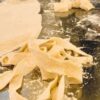
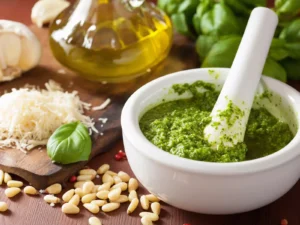
Pesto alla Genovese remains its clearest expression. Basil grows easily along these hills, and for centuries it has been crushed in mortar with pine nuts, garlic, aged cheese, and olive oil. Pesto alla Genovese clings naturally to trofie, a short, twisted pasta shaped to hold every trace of the sauce.
Focaccia exists everywhere here. Bakeries prepare it continuously through the morning, pulling flat golden sheets from the oven. The surface cracks lightly, leaving oil on your fingers, while the inside stays warm and soft. In Genoa, especially, focaccia is not reserved for meals. People eat it early in the day, sometimes alongside coffee, sometimes alone, simply because it’s there and is delicious.
Along the western Riviera, especially near Sanremo, sardenaira reflects an older tradition. This flatbread has existed for centuries, long before pizza became widespread. It is topped with tomato, anchovies, Taggiasca olives, capers, garlic, and oregano. There is no cheese, and we don`t miss it.
Fish and seafood are an important part of the Ligurian diet. And it makes sense, who can resist fresh fish bought straight from the fisherman? Every morning, boats unload their catch into small ports, and what arrives is prepared with minimal intervention. Before they get on our plate, anchovies, mussels, and Mediterranean fish are seasoned just with olive oil and lemon. The quality makes elaboration unnecessary.
Traditional Ligurian Pasta and Regional Specialities
Liguria’s landscape shaped its food long before recipes were written down. Narrow terraces allowed little space for livestock but supported herbs, olive trees, and hardy vegetables. Pasta shapes adapted to these conditions, too.
Trofie became inseparable from pesto. Their tight twists trap the sauce, ensuring each bite carries balance. Pansoti reflect the inland hills more than the coast. Filled with wild greens and served with walnut sauce, they have a deeper, earthier flavour.
Other dishes speak directly to survival. Brandacujun combines dried cod with potatoes, olive oil, and parsley. It developed from preservation, when fishing communities needed food that could last and nourish families. Today, it is still present and loved in the region.
In Genoa, you will find cima alla genovese. It is slowly cooked veal filled with vegetables, herbs, and egg.
Ligurian Street Food and Everyday Bites
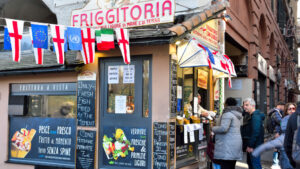
Food here moves with the rhythm of daily life.
Farinata appears first in bakery windows. Made from chickpea flour, water, and olive oil, it emerges crisp at the edges and soft in the centre. We eat it immediately, often standing outside the panificio, while it is still steaming.
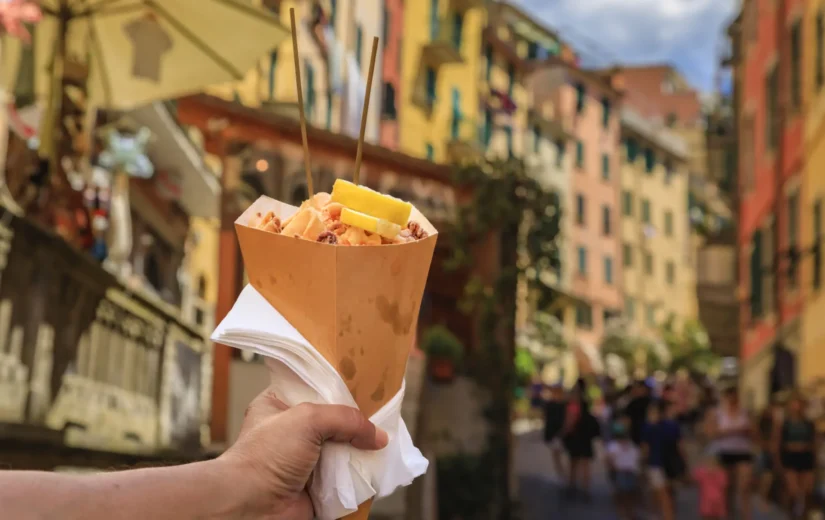
Panissa begins the same way but continues further. Once cooled, it’s cut and fried until the exterior turns crisp. Inside, it stays smooth and dense. It’s served in paper cones, carried through narrow streets and eaten without pause.
Among the local favourites are Fritters as well. Fritters are small fried bites, often made of zucchini flowers, onions, artichokes, and pieces of fish, dipped briefly in butter before frying. Cuculli, small chickpea fritters, are present as a savoury and sweet food
Genoa: The Birthplace of Ligurian Culinary Identity
To best understand Ligurian food, we need to look at Genoa.
Pressed between the Ligurian Sea and the mountains, the city grew into one of the most powerful maritime republics in the Mediterranean. Its port connected Liguria to distant shores, and ships returned carrying not only goods, but new ingredients that slowly entered local kitchens. Genoese cooks absorbed these ingredients and adapted them with restraint, shaping them according to their own habits and landscape.
Over time, the foundations of Ligurian cuisine took form here.
In the western districts of the city, particularly in Pra’, basil thrived in the mild coastal climate. It was here that pesto alla Genovese emerged, built from basil, pine nuts, garlic, olive oil, and aged cheese. Prepared with a mortar and pestle, it reflected the Ligurian approach to cooking, preserving the clarity of each ingredient.
Focaccia followed the same path. Baked in wide trays and enriched with olive oil, it became part of the city’s daily rhythm. It fed dockworkers, sailors, and families alike. What began in Genoa spread across the region, but its identity remained inseparable from the city.
How Genoa`s Port Shaped Ligurian Cuisine
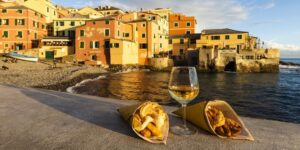
The port itself shaped what people ate. Fresh fish arrived constantly, and anchovies became a staple, eaten fresh, preserved, or lightly fried. Chickpea flour, durable and nourishing, gave rise to farinata, a simple food that sustained workers for generations.
These dishes answered the needs of a port city where ingredients had to be practical, accessible, and lasting. Over centuries, these habits became tradition. And those traditions became the foundation of Ligurian cuisine.
When you spend time in Genoa, you begin to understand that Ligurian cuisine was not created in isolation. It formed here gradually, shaped by geography, trade, and daily necessity. And there is no better way to experience this knowledge more directly, than to join authentic cooking classes in Genoa, and withness how these traditions continue in local kitchens.
– Katarina, your foddie buddy in Italy